Game creation has historically been a systems-first discipline. The foundational questions — what does the player do, what rules govern the world, how does the player win or lose — are answered before anything else. The emotional and aesthetic qualities that make a game memorable are downstream of those decisions, shaped by but not shaping the mechanical core.
The vibe coding game trend is changing this sequence in a way that feels small in description but is significant in practice. When creators begin from a feeling and use AI tools to build mechanics that serve that feeling, the relationship between emotion and system reverses. The feeling is upstream. The mechanics are in service of it. This is not a new philosophical position — it has been articulated by game designers for decades — but it is new as a practical, accessible workflow available to anyone with a browser and an idea.
Artists and Writers Are Making Games for the First Time
One of the most visible effects of the vibe coding game trend is the emergence of a new category of game creators: people from visual art, writing, music, and design backgrounds who are making games for the first time because the entry point now aligns with their existing creative practice.
An illustrator who has spent years creating melancholy, detailed scenes can describe the emotional world of those images to an AI game agent and receive a playable version of that world. A novelist whose work explores a particular psychological state can translate that state directly into an interactive experience. A musician who builds entire soundscapes around a specific feeling can use that feeling as the starting point for a game that inhabits the same emotional space. These creators were not blocked by a lack of creative vision — they were blocked by the technical requirements of conventional game development. The vibe coding game approach removes those requirements almost entirely.
Removing the Technical Wall Changes What Gets Made
When access to a creative medium expands, what gets made changes. Not just who makes it — what gets made. The games being produced through vibe coding approaches in 2026 are measurably different in their themes, their aesthetics, and their emotional registers from the games that conventional development workflows produce. They tend to be shorter, more focused on a single feeling, less concerned with mechanical challenge, and more willing to prioritise atmosphere over interaction depth.
This is not because these creators lack the ambition for more complex games. It is because their creative instincts lead them toward experiences where the feeling matters more than the systems. The technical wall that previously existed was not just blocking these creators — it was filtering out these kinds of games entirely. Removing the wall changes the landscape of what exists.
What Traditional Developers Are Learning From Vibe Coders
The influence of the vibe coding game movement is not confined to the creators who work entirely within it. Traditional developers — people with great technical skills and conventional game development backgrounds — are absorbing its lessons and applying them to their own work.
The most significant lesson is about emotional coherence as a design goal. Vibe coding games, at their best, are completely internally consistent in their feeling — every element serves the same emotional purpose. This coherence is something that systems-first development can easily lose when mechanics and aesthetics are designed somewhat independently and assembled into a game that works mechanically but feels fractured aesthetically. Seeing what emotional coherence looks like in practice, in games that have nothing but that coherence, is instructive even for developers who would never build that way themselves.
A New Kind of Game Creator Is Emerging
The vibe coding game workflow is producing a new kind of creator — someone who thinks about games the way a poet thinks about language or a filmmaker thinks about images. The starting point is always a feeling or an observation about experience. The tools are used to externalise and share that feeling. The measure of success is whether someone else feels something recognisable when they encounter the result.
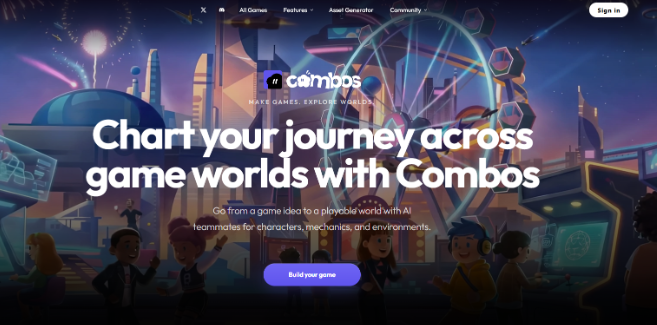
This is not a rejection of craft. The vibe coding creators who are producing the most resonant work are deeply thoughtful about their prompts, highly attentive to the aesthetic outputs they receive, and skilled at recognising when the result matches their intent and when it does not. The craft is different from a traditional developer’s craft — it is more editorial and curatorial — but it is not absent. Tools like Combos are developing this creative population by making the workflow accessible and producing results good enough to take seriously.
Conclusion
The vibe coding game trend is not a phase or a novelty. It represents a genuine expansion of who creates games and what games can be. By starting from feeling rather than system, it opens game creation to creative voices that conventional development workflows have always excluded. Combos supports this approach natively through an AI game agent that interprets emotional and aesthetic intent with genuine accuracy. The creative landscape is changing. The question is whether you want to be part of what it becomes.

